As identity threats become more sophisticated, physical credentials are being challenged to do more than simply prove possession. Today’s cards, IDs and access credentials must operate in an environment shaped by generative AI, deepfakes, spoofing, credential sharing and increasingly complex fraud attempts.
For the global card industry, this shift raises an important question: How can physical credentials remain trusted, useful and secure in a digital-first world?
According to International Card Manufacturers Association (ICMA) member Geoff Slagle, executive vice president of digital identity at FaceTec, the answer is not to replace physical credentials, but to strengthen the connection between the credential and the person presenting it.
“Traditional physical IDs rely on a possession-equals-authorization model,” Slagle said. “However, in the age of generative AI, this model is broken.”
That traditional model assumes that the person holding a card or ID is the rightful user. But as static photos become easier to spoof and credentials become easier to share, issuers and relying parties are increasingly looking for methods that can provide stronger assurance.
“A new model is required to move from guessing the user is correct based on possession of a physical thing to knowing that they are securely bound to trustworthy information riding on a physical credential,” Slagle said.
For card manufacturers, issuers and personalization providers, this represents a broader evolution in the role of the physical credential. The card is no longer just a carrier of printed, encoded or embedded information. It is becoming part of a larger identity ecosystem where physical and digital verification must work together.
Moving Beyond Static Identity
Traditional barcodes and QR codes have long offered a convenient way to store and retrieve information. However, they are generally static and can be copied, photographed or reproduced. In high-assurance identity environments, that creates limitations.
Emerging biometric barcode concepts are designed to address that gap by creating a stronger connection between the credential and the authorized user. Rather than relying only on possession, these systems can support what is often referred to as biometric binding: the process of mathematically linking a credential to the rightful owner’s biometric characteristics.
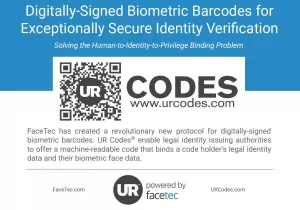
“The UR Code is revolutionary because it is a cryptographically signed, privacy-preserving container for biometric data,” Slagle said.
In practice, this type of approach can allow a credential to carry secured identity information that can be verified against the person presenting it. The goal is not simply to confirm that the card is present, but to confirm that the card and the presenter belong together.
This has significant implications for physical credentials used in government ID, financial services, employee access, education, healthcare and other environments where identity assurance is critical.
Supporting Both Physical and Digital Use Cases
One of the most important developments for the card industry is the growing need for credentials that can function across both in-person and remote environments.
In a physical access setting, a credential could be scanned and matched to the presenter’s face to support higher-assurance building entry, campus access or secure facility access. In a remote or hybrid environment, the same credential could support identity verification through a smartphone or standard camera.
This is especially relevant as more organizations look for ways to reduce friction while maintaining strong security. A physical card may still be the familiar, trusted object that users carry, but it can also serve as a bridge to digital verification workflows.
Slagle noted that technologies such as 3D liveness detection can help confirm that the person presenting the credential is a real, live human being rather than a photo, mask, video replay or AI-generated deepfake. For issuers and relying parties, this is becoming increasingly important as fraud tactics grow more advanced.
Privacy Remains Central
While biometric technologies can strengthen identity assurance, they also raise important privacy questions. For issuers, governments, enterprises and consumers, the way biometric data is stored, protected and used is central to trust.
“One of the biggest hurdles in modernizing IDs is the fear of creating a biometric honeypot,” Slagle said. “Biometric barcodes solve this through decentralization and data sovereignty.”
The concern is that centralized databases of biometric information could become attractive targets for attackers. Decentralized models seek to reduce that risk by avoiding large centralized stores of sensitive biometric data.
According to Slagle, FaceTec’s approach stores face vectors rather than human-viewable images. These vectors cannot be reconstructed into a photo of the person. In addition, its software can operate within an issuer’s own firewall, and session data tied to liveness checks is deleted immediately after use.
For the card industry, this highlights an important principle: Stronger credentials must be designed with privacy protections built in from the beginning. Security, usability and data protection can no longer be treated as separate considerations.
Expanding Applications Across the Credential Ecosystem
The potential use cases for stronger biometric-bound credentials extend across many markets served by the card industry.
Government agencies could use these approaches to strengthen driver’s licenses, passports and national IDs. Schools and universities could help reduce proxy test-taking while improving campus access. Employers could enhance both physical facility access and digital systems access. Healthcare organizations could improve patient matching and reduce identity-related fraud.
Because many of these technologies can work through standard cameras, they may offer a practical path for organizations seeking stronger verification without requiring expensive specialized hardware at every point of use.
For manufacturers, personalization bureaus, issuers and technology partners, this evolution creates new opportunities to rethink how physical credentials are designed, produced and integrated into larger identity systems.
A New Role for the Physical Credential
The larger takeaway for the global card industry is clear: Physical credentials are not going away, but their role is changing.
Cards and IDs are increasingly expected to support stronger security, better privacy, digital interoperability and more reliable proof that the person presenting the credential is the rightful holder. In a world where 2D images can be spoofed and AI-generated fraud is becoming more sophisticated, static credentials may no longer be enough.
The future of physical credentials will likely depend on how effectively the industry can combine trusted card manufacturing, secure personalization, cryptographic protections, biometric verification and privacy-conscious architecture.
For Slagle, the goal is to help make credentials harder to share, harder to phish and harder to misuse, while maintaining the usability that makes physical cards so valuable.
As identity threats continue to evolve, the card industry has an opportunity to help define the next generation of secure credentials—ones that do more than carry information. They help establish trust.
Why ICMA Membership Matters
ICMA remains committed to empowering the global card manufacturing community by helping members lead, innovate and grow. Through a strategic combination of industry marketing support and professional development, ICMA equips organizations and individuals with the tools they need to stay competitive in a rapidly evolving marketplace.
ICMA’s professional development programs are designed to strengthen both technical expertise and leadership capability. Offerings such as on-demand Advanced Card Education (ACE) and the Card Industry Training & Education (CITE) initiative help professionals deepen their knowledge, while flagship events like the EXPO and CardTREX bring together industry leaders to learn, connect and explore emerging innovations.
Members who engage in ICMA’s education programs and events don’t just keep pace with change—they help shape it. From contributing thought leadership to Card Manufacturing magazine to earning industry recognition through the Élan Awards of Excellence, ICMA provides meaningful opportunities for members to elevate their visibility and influence.
For card industry professionals seeking to stay informed, connected and future-ready, ICMA offers a clear path forward through education, exposure and community.
Discover the full value of ICMA membership and join a global network of professionals advancing the card industry.