
A gift card might spend a few days in a wallet before it’s redeemed. A membership card might spend years there, rubbing against other cards and coming out at every visit. For retailers considering a switch from plastic to fiber-based cards, that difference helps determine how thick, stiff and moisture-resistant a card needs to be.
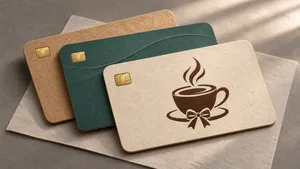
Gift cards are a visible part of the retail experience and have traditionally been made with polyvinyl chloride (PVC) or other plastics, said International Card Manufacturers Association member Chloe Jones, director of marketing and communications at Monadnock Paper Mills. As retailers rethink the materials in shopping bags, packaging, signage, shelf displays, fixtures and promotional materials, card programs give them another way to reduce reliance on single-use plastics, increase recycled content and advance corporate sustainability goals. The card still has to hold up in use and reflect the brand.
Match the Material to the Life of the Card
“The first consideration should be the intended life and use of the card,” Jones said.
A gift card may only need to hold up through shipping, display, gifting and redemption. A loyalty or membership card may face months or years of handling, friction, bending, moisture and temperature changes. Those conditions determine the appropriate caliper, or thickness, along with stiffness, surface characteristics and durability.
One engineering challenge has been matching the familiar thickness, rigidity and feel of a plastic card. Fiber selection, sheet construction and surface treatments now give suppliers more ways to adjust those properties and manage moisture resistance. Jones said Monadnock offers paper card stocks from 14 to 30 points, with options for different card formats, printing methods and performance requirements. She described four examples.
- Envi® Card uses renewable fiber certified by the Forest Stewardship Council (FSC). The plastics and PVC alternative come in several thicknesses and has a smooth, bright white surface.
- Envi PC 100® Card uses FSC-certified, 100% post-consumer recycled fiber and is designed to meet the printing and converting needs of gift and loyalty programs.
- Renovo® is a 30-point gift card stock made with FSC-certified, 100% post-consumer recycled fiber. It was engineered for rigidity, durability and the feel of a premium gift card.
- Compostable Card is an engineered board made with FSC-certified, 100% post-consumer recycled fiber. The board carries TÜV OK compost HOME certification. Jones pointed to it as an option when long service life and resistance to moisture or temperature changes are less critical. Monadnock designed the board to resist moisture and remain stable through temperature changes during use.
Test the Finished Card on Production and Retail Equipment
“Testing should be application-specific and should evaluate the finished card, not just the raw paper,” Jones said.
Jones recommends bringing the substrate supplier, card manufacturer, personalizer and retailer together early. Agree on performance requirements, then run trials on the equipment and systems the card will encounter. Laboratory testing can reveal how a card responds to moisture or bending. A trial on a high-speed personalization line or a store’s point-of-sale system can reveal different problems. Jones said Monadnock’s paper card stocks can accommodate magnetic stripes, barcodes, scratch-off and signature panels, embossing, foil stamping and lamination. Each combination should be qualified on the finished card.
- Printing. Check compatibility with the intended press and inks, along with color reproduction, drying, registration and ink adhesion. Jones said Monadnock’s gift card stocks are designed for conventional offset, UV, flexographic and a range of digital printing platforms.
- Die-cutting and physical integrity. Check caliper, stiffness, snap, dimensional stability, edge quality and consistent card geometry. Test bending and check for cracking or delamination.
- Personalization. Test magnetic stripe adhesive, encoding and read performance. Check print contrast, registration and readability for barcodes and variable data. For scratch-off and signature panels, check adhesion and compatibility with hot or cold glues as applicable. Make sure the scratch-off coating removes cleanly without damaging the card.
- Finishing and converting. Check foil adhesion, embossing, lamination, registration, appearance and durability. Test how the card attaches to its carrier and look for abrasion, scuffing and scratching after handling.
- Distribution and use. Test packaging, shipping, storage, merchandising, activation and redemption. Expose samples to the humidity, moisture and temperatures they may encounter. For loyalty and membership cards, simulate wallet storage, repeated handling and bending.
Jones offered an example of how Monadnock tests durability. In the company’s boiling-water tests, its 28- and 30-point gift card stocks stayed intact after about 50 minutes or longer, she said. The stocks are designed to survive accidental laundering. The trial illustrates how a supplier can test for a specific type of exposure, while each card program still needs trials that reflect its own use and construction.
“Handling paper stock is different from plastic,” Jones said. Temperature, relative humidity and sunlight can affect paper stock before it reaches a press or die cutter. She said Monadnock draws on decades of papermaking experience to advise customers on storage and handling through production, packaging and shipping. Discussing those conditions up front gives teams time to address problems before a full production run.
Verify Environmental Claims for the Finished Card
“A material that is recyclable on its own does not automatically mean that every finished card configuration is recyclable,” Jones said. “The same applies to compostability.”
Coatings, adhesives, magnetic stripes, foils and laminates can change how a finished card is handled at end of life. Jones recommends checking what the testing or third-party certification covers, whether it applies to the finished construction and which collection and processing options customers can access. For a home-compostability claim, verify that the applicable TÜV certification is current and covers the configuration in question.
Different certifications address different questions. Monadnock offers engineered paperboard products designed as recyclable alternatives to PVC, including options made with 100% post-consumer recycled fiber. Its Compostable Card certification covers the material’s ability to break down under home-composting conditions. Mastercard’s Card Eco-Certification (CEC), meanwhile, applies to specified 28- and 30-point Monadnock substrates and is based on a life cycle assessment independently verified by TruCert. In comparing certified stock with plastic card stock, Jones cited reductions in greenhouse gas emissions, including impacts associated with transportation, as well as in total energy and nonrenewable energy use, total material use, including nonrecycled and nonrenewable inputs, and the amount of product sent to landfill or incineration.
How Blackhawk Network and Monadnock Developed Renovo
Blackhawk Network (BHN), a gift card aggregator, wanted a fiber-based alternative that could retain the thickness, rigidity and premium feel shoppers associate with a traditional plastic gift card. Working with Monadnock, BHN developed Renovo using 100% post-consumer recycled fiber and coatings engineered to improve strength, durability and compatibility with multiple printing platforms. The project tied the choice of fiber and coatings to both the look and feel of the gift card and the demands of manufacturing it.
Fiber-based cards were already in wide use before that project. In 2021, Monadnock reported that retailers, restaurants, hotels and other brands had produced more than 10 billion gift, membership and loyalty cards using Envi Card stock over the preceding decade.
For a retailer planning a switch, the first design meeting is the place to settle three questions. How long does the card need to last? What must it do on the production line and at checkout? And which environmental claims can the team substantiate for the finished card? Those answers give the retailer, supplier, manufacturer and personalizer a common set of requirements before anyone commits to a stock or finish.
Connect With the People Behind New Card Materials
A fiber-based gift or loyalty card has to work on the production line, at checkout and throughout its intended life. At ICMA’s EXPO and CardTREX, material suppliers, card manufacturers and personalizers from across the global card ecosystem share what they’ve learned about testing new materials and bringing them into production. Explore ICMA membership benefits to connect with the people who can help you evaluate materials for your next card program.