
by Jennifer Kohlhepp | CM Magazine Featured
From Detection to Prevention: AI-Augmented FMEA for Dual-Interface CardProduction

By Siva Ravi, Director of Operational Excellence, Marketing Card Technology LLC
Problem Definition
T-Connect dual-interface card manufacturing operates within extremely tight tolerances, were small variations in materials, machine settings, environmental conditions, or component certifications can quickly become major quality failures. Traditional quality systems detect problems after they occur, and even modern equipment only alerts operators once abnormalities appear. Neither prevents defects before cost is embedded in the card. This article presents a unified framework to close that gap: ABCXYZ analysis to classify external risk before it reaches the line, AI-enhanced FMEA to reduce defect escape through inline verification, and AI-PDCA to sustain continuous intelligence and expose the compliance blind spot many manufacturers still miss.
1. The Critical Risk Zone: Where Profit Is Won or Incinerated
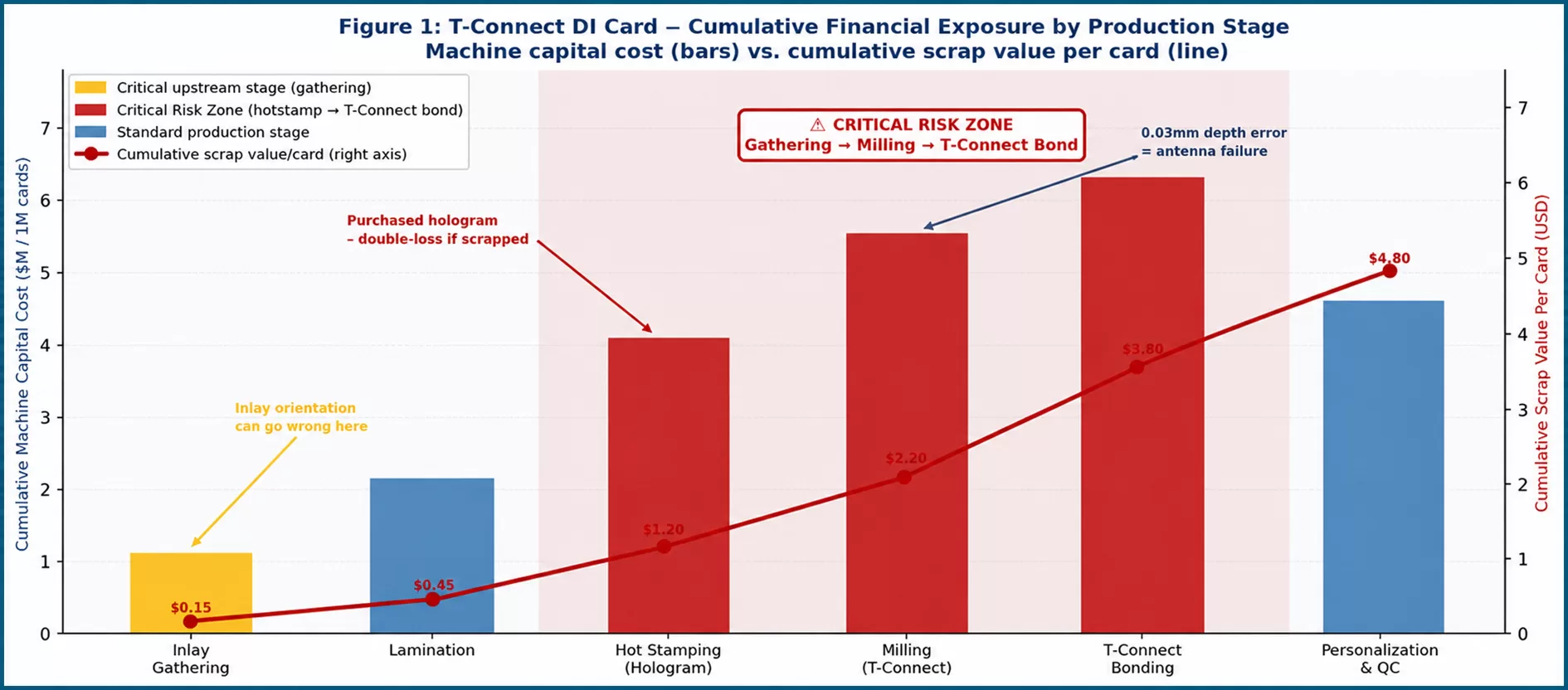
Financial risk in T-Connect dual-interface card manufacturing escalates quickly as defects move downstream. Inlay misorientation silently destroys contactless function, hot-stamp adhesion failures create double-loss scrap, and even a 0.03 mm milling error or slight variation can break electrical performance.
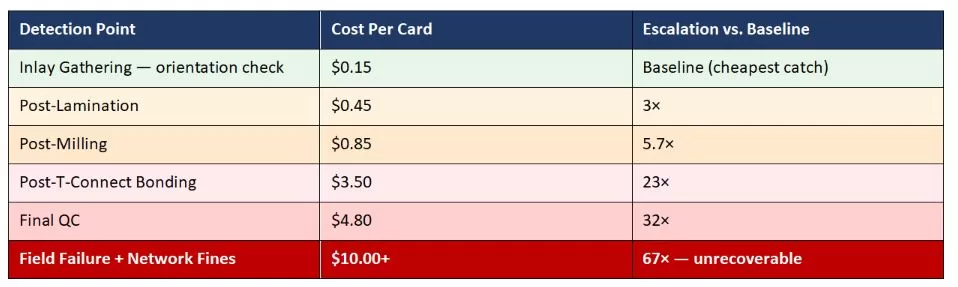
Cost of Poor-Quality rises with every missed defect, while AI-enabled inline verification interrupts that curve at the earliest stage, before value is added and loss is locked in.
2. ABCXYZ + The Compliance Blind Spot: Mapping What Can Kill a Run
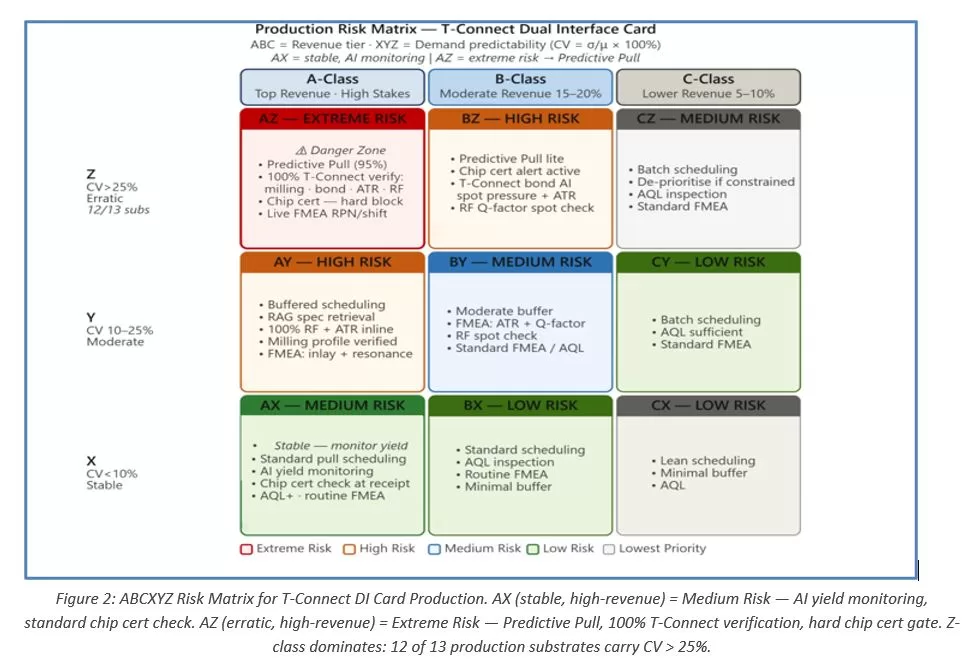
Many T-Connect DI production disruptions originate upstream, in external dependencies that manufacturers cannot control but must still absorb. ABCXYZ analysis makes these risks visible before they reach the line.
ABCXYZ is a dual-dimension classification framework:
· ABC (Revenue Tier): Ranks jobs by revenue contribution. A-class = top 70–80%; B-class = next 15–20%; C-class = bottom 5–10%. This identifies where the financial stakes are highest.
· XYZ (Demand Predictability): Ranks by how consistently external inputs arrive — artwork approvals, milling profiles, chip specifications, data files. X = predictable; Y = moderately variable; Z = erratic.
The mathematics: Coefficient of Variation (CV) XYZ classification is calculated using the Coefficient of Variation: CV = (σ / μ) × 100% — where σ is the standard deviation and μ is the mean of a demand variable over a 12-month rolling period. CV < 10% = X. CV 10–25% = Y. CV > 25% = Z. Real production data shows 12 of 13 substrate stocks carry CV > 25% — meaning Z-class conditions are the operational norm in T-Connect DI supply chains, not the exception.
The AZ combination of strategic revenue, erratic external data is the Danger Zone. Traditional push scheduling guarantees idle capital and missed SLAs. Predictive Pull uses AI to analyze historical approval variability and data delivery performance, staging high-value T-Connect materials only when the probability of an uninterrupted run reaches 95% converting volatility into managed probability.
Embedded within the AZ danger zone sits the industry’s most underestimated risk: chip certification expiry. Payment networks require valid EMV certification at card issuance. Producing 500,000 T-Connect DI cards with an expired Mastercard M/Chip Advance certification creates a Compliance Time Bomb — the entire run is non-compliant.
Compliance responsibility rests with the issuing bank, but the card manufacturer is the last operational checkpoint capable of catching this before issuance. In complex supplier-issuer ecosystems, that checkpoint is frequently missed. A review of certification portfolios in 2026 revealed multiple Mastercard certifications already expired, with additional certifications approaching expiry within the same year
AI-enhanced FMEA addresses this by incorporating certification status as a formal pre-production gate identified at job receipt, before a single card enters production. The cost of correction at that point is minimal. The cost of discovery is not.
3. AI-Enhanced FMEA: Zero-Defect T-Connect DI Structure
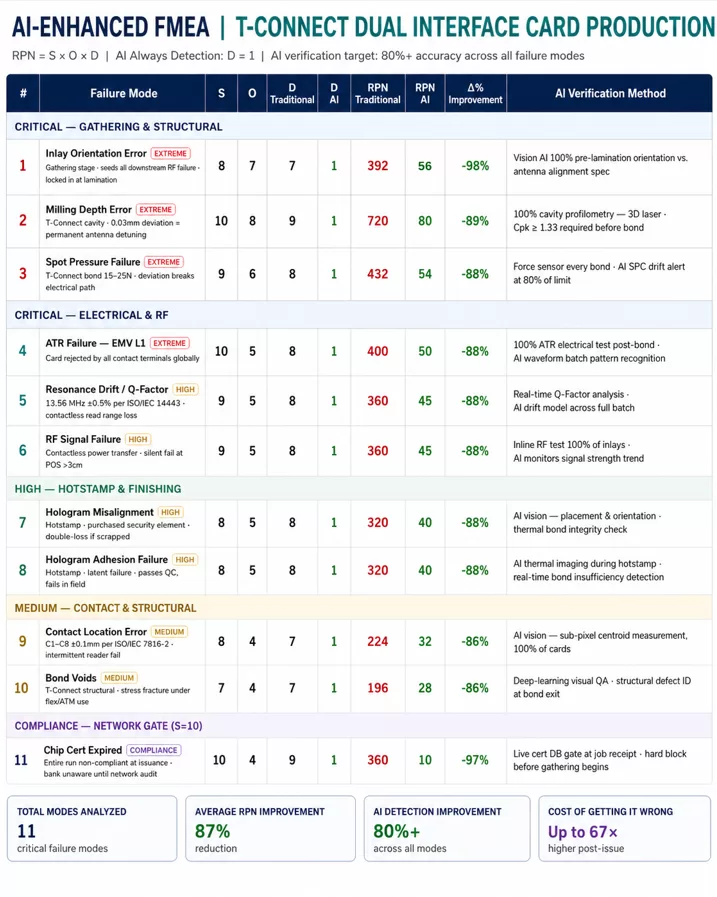
Failure Mode and Effects Analysis (FMEA) is the engineering methodology used to systematically identify every way a process can fail, assess the severity of each failure, and prioritize preventive action. Each failure mode is scored across three dimensions: Severity (S) how damaging is the outcome; Occurrence (O) How likely is the failure; Detection (D) how reliably is it caught before reaching the customer. These three scores multiply to produce the Risk Priority Number: RPN = S × O × D. Higher RPN = higher risk, higher priority for intervention.
Traditional AQL-based inspection methods evaluate only a statistical sample of production output, allowing some defects to escape detection. Consequently, many failure modes receive moderate Detection ratings within conventional FMEA assessments. By contrast, AI-enabled 100% verification systems can evaluate every card produced, substantially improving defect detection capability and reducing Detection rankings across multiple failure modes. When integrated with machine sensor data from platforms such as the Mühlbauer DICL 5000, AI algorithms can identify patterns, anomalies, and emerging process risks in near real time. The inspection system provides the sensing infrastructure, while AI enhances decision-making through continuous analysis and early-warning detection of potential quality failures.
T-Connect technology increases the sensitivity of the manufacturing process to structural defects. A milling depth deviation of 0.03mm invisible to the naked eye permanently detunes the antenna. An ATR (Answer to Reset) failure can prevent successful communication between the card and compatible contact terminals. A Q-factor drift at 13.56 MHz means contactless transactions fail silently at distance. Inlay orientation errors seeded at gathering are locked in permanently at lamination. The objective is not merely defecting detection, but the reduction of risk through earlier identification and control of failure modes. The AI-FMEA model targets all eleven failure modes across the full T-Connect process.
4. The AI-PDCA Cycle: From Reactive to Proactive Intelligence
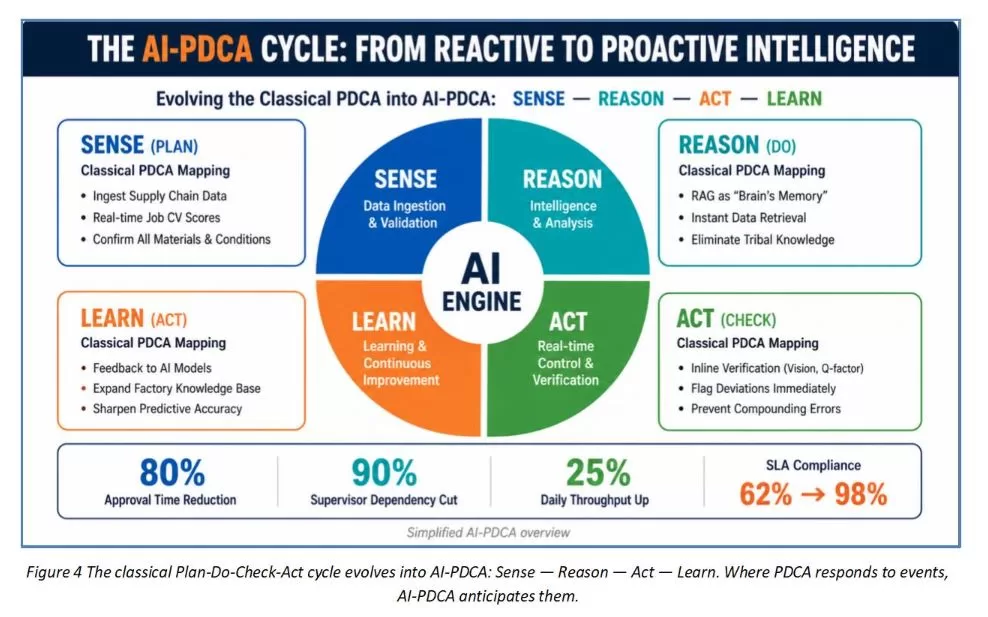
AI-PDCA extends the traditional Plan-Do-Check-Act methodology by continuously learning from production outcomes. Sensor data, quality results, machine alarms, certification events, and production performance metrics are analyzed to identify emerging patterns and recommend corrective actions before performance degradation occurs. As a result, improvement becomes continuous rather than event driven.
5. Case Study: Global Bank Issuance — From Volatility to Velocity
A global financial institution launched a 2.5–5-million-unit T-Connect dual-interface card program with custom holograms, precision milling, and tightly controlled inlay specifications. The program operated in a high-variability environment where approvals were unpredictable, data deliveries inconsistent, and last-minute engineering changes frequently disrupted production. Because materials were specialized and non-substitutable, delays created immediate cost exposure. Producing early increased risk of expensive T-Connect bond and hologram scrap, while producing late risked SLA penalties. The result was a frozen pipeline, rising WIP, and heavy dependence on supervisor judgment.
To stabilize operations, two integrated interventions were deployed over roughly nine months on a single dual-interface production line. Predictive Pull applied ABCXYZ segmentation and coefficient-of-variation analysis to release materials only when execution confidence reached a 95% run-probability threshold. In parallel, AI-enhanced FMEA enabled 100% inline verification of inlay orientation, milling depth, T-Connect bond integrity, Q-factor performance, and hologram placement.
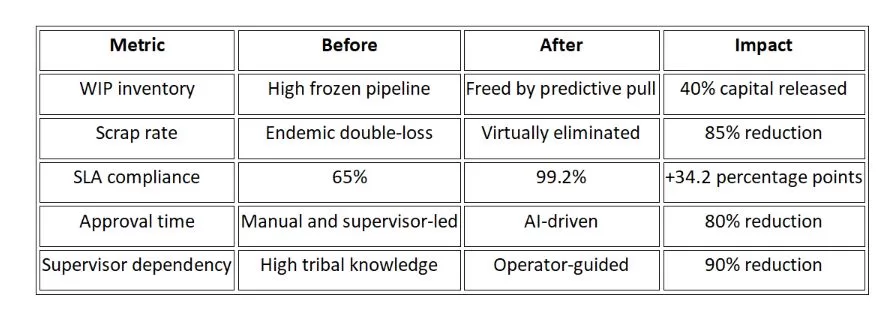
The effect was systemic rather than incremental. WIP inventory fell by about 40%, scrap declined by roughly 85% to low single digits in the Critical Risk Zone, SLA compliance improved from 65% to 99.2%, approval time dropped by 80%, and supervisor intervention requirements decreased by 90% on the pilot line. Together, Predictive Pull and AI-enhanced FMEA converted volatility into predictable throughput and reduced reliance on judgment calls.
Lessons Learned by the Deployment
· Data readiness outweighed algorithm complexity, requiring integration of MES, sensor, and certification data before enabling reliable AI-driven decisions.
· Cross-functional ownership ensured alignment across quality, production, planning, IT, and engineering, preventing siloed implementation.
· A phased rollout, starting with a single production line and limited SKU scope, minimized risk and built operational confidence before scaling.
· Pairing disciplined material release with real-time verification converted operational volatility into predictable throughput.
· The combined approach improved cost control, accelerated decision-making, and strengthened quality performance without increasing operational complexity or manual oversight.
Conclusion: The New Standard and the Cost Standing Still
ABCXYZ identifies external variability before production begins. AI-enhanced FMEA manages structural risk during execution. AI-PDCA continuously learns from outcomes to refine both. Together, they form a closed-loop operational intelligence framework for dual-interface card manufacturing.
T-Connect programs have pushed smart card manufacturing beyond the limits of traditional quality systems. Inlay orientation errors during gathering, hologram misfeeds in hot stamping, milling deviations as small as 0.03 mm that disable contactless functionality, and unnoticed chip certification expiry are not edge cases—they are systemic risks that compound across production.
The cost of failure is exponential. A defect detected at inlay gathering costs approximately $0.15 per card; the same issue at field failure can exceed $10.00 plus network penalties—a 67-fold escalation. Without comprehensive inline verification and predictive release discipline, this multiplier silently impacts every unit shipped.
This framework is not theoretical. It operationalizes capabilities most plants already possess applying ABCXYZ variability scoring before material release, enforcing AI-driven FMEA during production, and using AI-PDCA to continuously refine performance based on sensor and quality data. What is often missing is decision architecture—connecting inspection data to dynamic FMEA models, enforcing chip certification as a pre-production gate, and aligning production release with variability signals.
Manufacturers who implement this approach will move beyond simple scrap reduction. They will transform volatility into controlled probability, strengthen their position as reliable partners to issuers, and build a competitive advantage in a market where price pressure is constant and operational intelligence is the differentiator that lasts.
References
[1] RT Insights “Leveraging AI and RAG in Supply Chain Optimization” (2024)
[2] ARC Advisory Group “Grounding Supply Chain AI in Real-Time Data” (2024)
[3] AI Vision Systems “Precision 3D Scanning for Manufacturing Quality Control” (2023)
[4] Industrial Vision Technology “Micron-Level Alignment for Automated Assembly” (2023)
[5] Deep Learning for Quality Assurance “Automated Defect Detection in Manufacturing” (2024)
[6] ISO/IEC 14443-2:2020 — Contactless proximity cards: Radio frequency power and signal interface
[7] ISO/IEC 7816-2:2007 — Identification cards: Dimensions and location of the contacts
[8] ISO/IEC 7816-3:2006 — Cards with contacts: Electrical interface and transmission protocols
[9] ISO/IEC 10373-1:2023 — Identification cards: Test methods
[10] EMVCo — EMV Level 1 Contact Interface Specification v3.0 (current edition)
[11] AIAG FMEA-4 Reference Manual — Risk Priority Number methodology (4th edition)
[12] Scholz-Reiter, B. et al. (2012) “Analyzing and Improving Planning Processes in Semiconductor Supply Chains Using the Coefficient of Variation” CIRP Annals, Vol. 61
[13] Mühlbauer AG — DICL 5000 Technical Documentation and Application Notes (2023)
[14] ICMA EXPO 2026 AI Roundtable — “Shaping AI’s Role in the Future of Cards” — Industry Veteran Panel Discussion, CM Magazine / ICMA, May 2026 (Peer discussion among senior card manufacturing practitioners with 20–35 years of industry experience; J. Kohlhepp et al.)
[15] ICMA Performance Metrics Task Force “Manufacturing and Personalization Performance Benchmarks” — International Card Manufacturers Association (icma.com/performance-metrics)
[16] Mastercard Rules — Chip Product Certification Requirements (June 2026 edition)
[17] Visa Core Rules and Visa Product and Service Rules — EMV Chip Certification Policy (current edition)
About the Author: Siva Ravi is Director of Operational Excellence at Marketing Card Technology LLC in Downers Grove, Illinois. With more than a decade of leadership experience in manufacturing processes, he specializes in operational excellence, quality systems, Lean transformation and the practical application of emerging technologies such as AI-enhanced FMEA, RAG-driven quality intelligence and data-driven continuous improvement. His work in quality management, operational excellence and Industry 4.0 transformation is supported by extensive professional certifications and active engagement with leading organizations, including the American Society for Quality (ASQ), Six Sigma Global Institute (SSGI), TÜV Deutschland and Industry 4.0 practitioner communities. Siva has presented research on AI-enhanced 8D problem solving, next-generation smart logistics and data-driven auditing at international conferences and professional forums, including IEOM and ASQ. He is passionate about bridging traditional manufacturing expertise with modern AI and analytics to improve quality, efficiency and operational performance. Outside of work, Siva competes in Chicago-area cricket game leagues, applying the same discipline, strategic thinking and teamwork that define his approach to manufacturing and quality leadership.